Send your discussion notes: Notes@EnergyKiteSystems.net HGAusa Lift
In year1960: hybrid kite glider
Tony Prentice enters elite history at age 13.
|
..
the 1960 glider was not inspired or influenced by any NASA offerings. The first Rogallo type I produced was in 1969 and the picture of the Ryan flex-wing was the picture I saw in the mid 60's that gave the idea. ~~ Arp, May 26, 2012. May 27, 2012 (yet to be completed. Does anyone have a question for Arp about his 1960 hang glider?
UpperWindpower: We know you by Tony Prentice and "Arp" in hang
gliding online. Arp: My full name, not often used is :- Anthony Richard Prentice UpperWindpower: Where on the map were the flights and experience of the 1960 hang glider? Arp: I lived at Penrose Buildings, Penrose Street, Walworth London SE17 UpperWindpower: Who built the hang glider? Arp: The wing was built by myself, but the sail machining was done by my mum. UpperWindpower: Were you in the scouts at age 13? Arp: Yes I was in the 5th Southwark Scout Group. UpperWindpower: Did you let others have an experience with your wing?
Arp:
Others in our group
of friends tried it out and one small lad was kited up in a strong wind.
UpperWindpower: For
your 1960 hang glider, what may have inspired your design and build;
Arp:
The 1960 glider came from building a series of kites of different designs.
It is basically a high aspect ratio diamond kite with additional cross
struts and preformed aerofoils. Reflex is provided at the tail for
aerodynamic balance. UpperWindpower: Do you recall how thoughts of human-on-board gliding kite came into your scene at age 13 or before? Arp:
I was fully aware of both Lilienthal and Pilcher and built many models
using radial fingers like that in a bat's wing. Construction of a full
size Lilienthal type started in 1963 with some trials in 1964. It was not
until 1968 that proper trials could take place on a hill at Brasted, Kent.
(yet to be completed. Does anyone have a question for Arp about his 1960 hang glider?
|
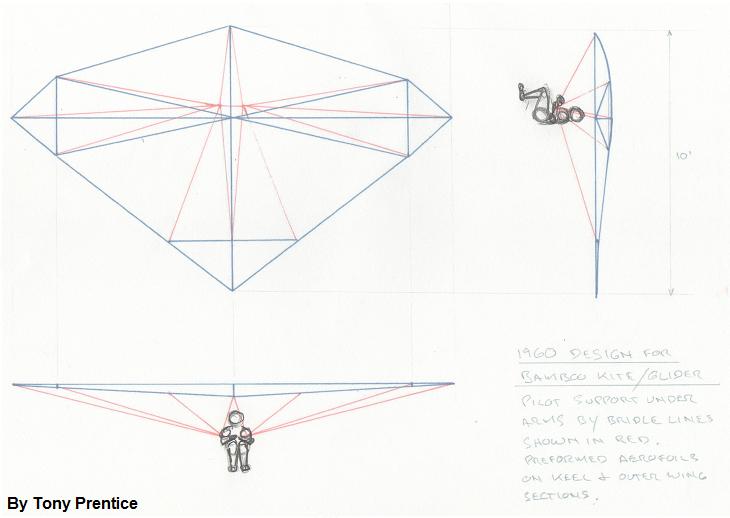
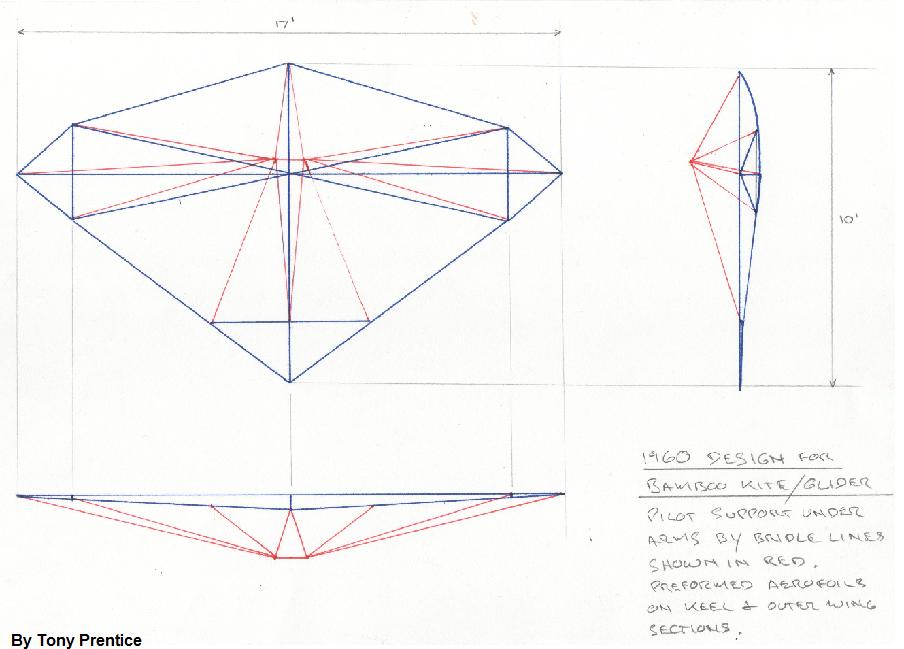
Rotated and reduced-sized image in jpg format without pilot position indication for the 13-yr old boy:
(See
sometime in
April
2010 Lift for dimensions for
185 lb experimentalist.)
http://www.energykitesystems.net/Lift/TonyPrentice/KiteGliderOf1960byTonyPrentice.jpg

As promised, please find attached sketch of my 1960 bamboo glider.
Although it only has a 17 ft wing span, it gave enough lift for a 13 year old
to get off the ground. The bridle forms a triangle in front of the pilot,
but, of course, it is not rigid. The weight of the pilot is used, via the bridle,
to load up the wing spars which spreads the load in much the same way
as PG lines. This enables a much lighter framework to be used.
If I scaled it up for my present weight I am sure its glide angle would be
better than the early Rogallo HGs.
~~Tony Prentice 30 March 2010
Furthering, Tony is supplying Joe and others:
- http://www.energykitesystems.net/Lift/TonyPrentice/1960modifyFOR185poundpilot.jpg March 31, 2010
Large file
- http://www.energykitesystems.net/Lift/TonyPrentice/1960_001.jpg April 6, 2010:
Large file
- http://www.energykitesystems.net/Lift/TonyPrentice/1960_002.jpg April 6, 2010:
Large file
- http://www.energykitesystems.net/Lift/TonyPrentice/1960_003.jpg April 6, 2010:
Large file
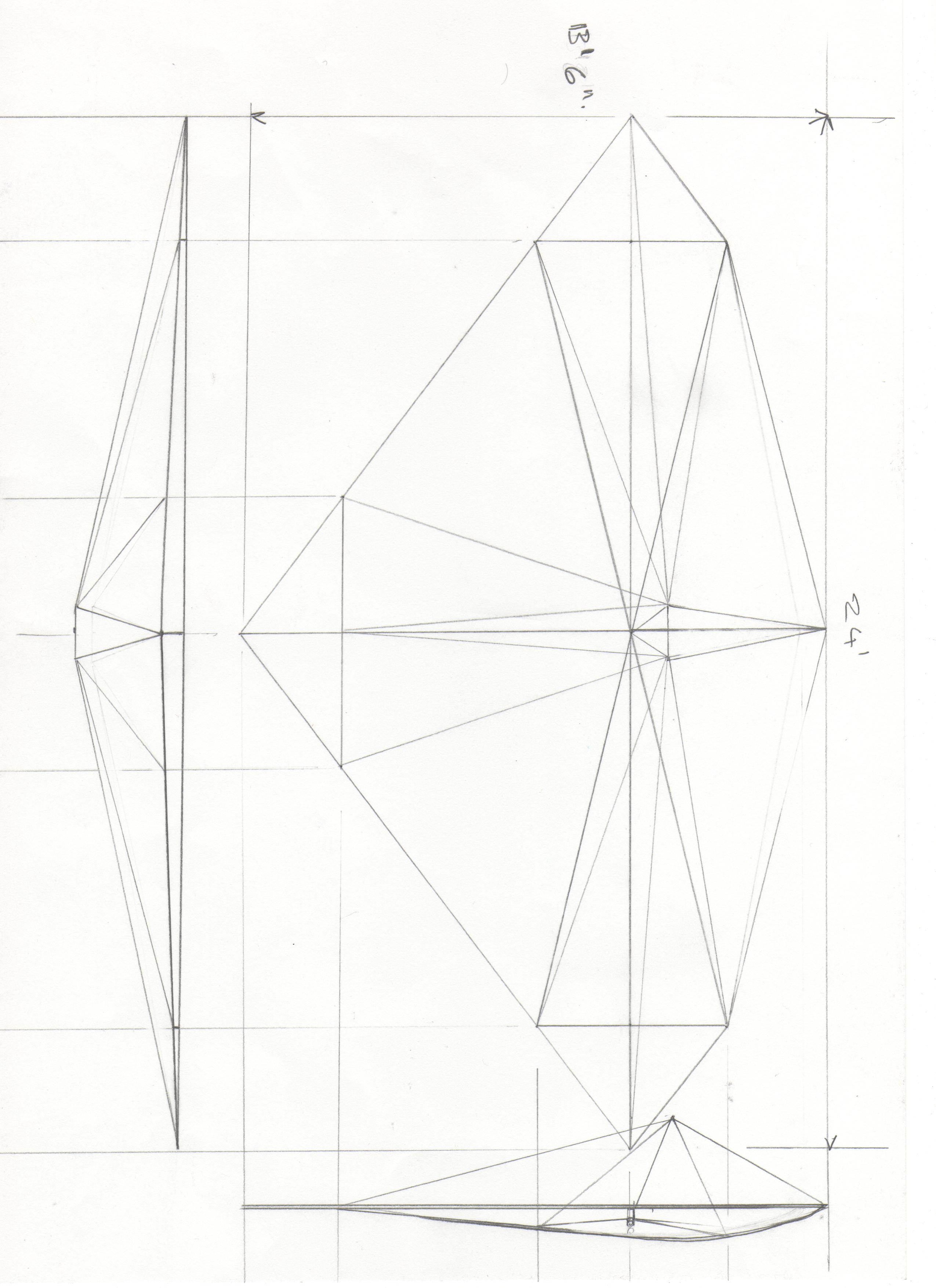
- March 31, 2010 I have attached a scaled up drawing to account for a pilot weight of around 185 lb. This gives a wing span of 24 ft and keel of 13 ft, 6 in. If you do intend to build, then I could supply you with a bit more detail. The original was built with available materials and the longest bamboo was 9 ft. When overlapped in the middle the span ended up at 17 ft. With tubing joiners and 12 ft bamboo a 24 ft span can be built. There are two diagonal spars which are coupled at their tips with the preformed airfoil struts. These are bamboo and the curve is made by using a "bow" string to the required shape. The keel is formed by a straight base pole and a curved (bent) top pole. The tail is a straight pole at 90 degrees to the keel and gives required reflex.
Even in those days I could not understand why towed "flat" kites had the sail below the cross spar resulting in a distortion of the aerofoil. I suspect that this was a mistake and the cross spar should be above the sail. If this was done you end up with a very low aspect ratio Rogallo shape. I noticed Graeme was going on about them being "5" point kites when in reality they are standard diamond kites with the keel truncated. In my 1960 design I has built a high aspect ratio diamond kite with additional diagonal wing spars. The sail remains above the wing spars which have pockets to contain them further out. The tail is formed by a cross strut holding the rear of the sail and then reflexes it for pitch stability.
Regards, ~~~~Tony
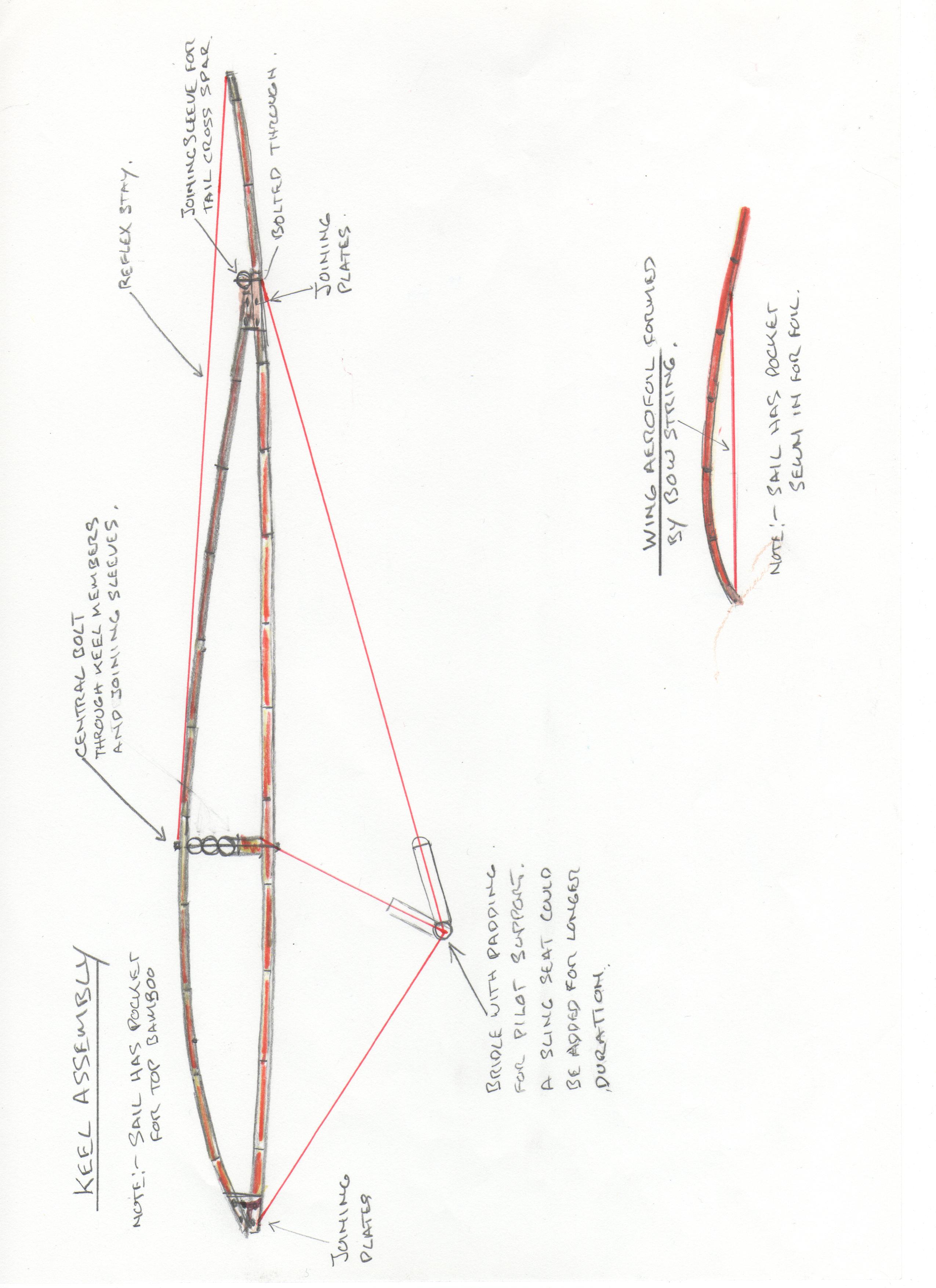
- April 6, 2010: Please find further sketches on the 1960 glider.
For clarity, the keel assembly and wing aerofoil are shown at twice the size of the other drawings.
Where bamboo is to be bolted through an aluminum sleeve is used to stop splitting. The nearest size tube to the bamboo diameter should be used and pack out with tape for a good fit.
To prevent any splits spreading whipping of the bamboo will re-enforce it.
The sail pockets for the wing spars should be made so that they do not distort the aerofoil shape. A cord is used around the sail perimeter and secures the airframe to the sail with aluminum tube caps. A pin is inserted into the cord to stop the end cap moving once aligned.
The leading edge thickness could be built up by sliding insulation foam tube over the cord inside the pocket. Re-enforce sail at stress points as per normal sail practice.
Regards, ~~~~Tony- April 6, 2010. Tony, I have started collecting bamboo. I obtained sail material. Workspace is cleared. ~~~~JoeF
Discussion is open: Send your discussion notes: Notes@EnergyKiteSystems.net

 In
1960
In
1960
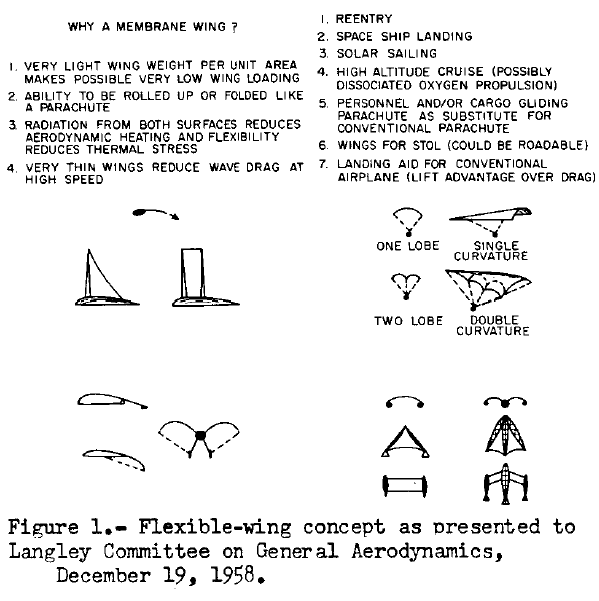
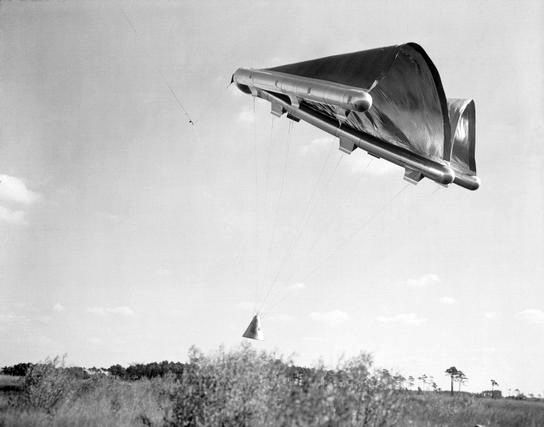
 Francis Rogallo,
et al, had already demonstrated flexible tethers up to framed flexible wing
glider. One demonstration is pictured on Internet where Francis had a man-doll
hung for a glide inside a hangar.. But in 1960, there might not
have yet been a framed kite glider with flexible bridle as the lower
"airframe" with a live boy lifted off the ground beyond your experience,
Tony; such--as intentional--might have a competition with some conjectured unintentional hanging from kite
tether from released-mooring manned kiting incidents for which I have no reference for
at the moment Though Leonardo da Vinci had the square framed
pyramidal parachute
Francis Rogallo,
et al, had already demonstrated flexible tethers up to framed flexible wing
glider. One demonstration is pictured on Internet where Francis had a man-doll
hung for a glide inside a hangar.. But in 1960, there might not
have yet been a framed kite glider with flexible bridle as the lower
"airframe" with a live boy lifted off the ground beyond your experience,
Tony; such--as intentional--might have a competition with some conjectured unintentional hanging from kite
tether from released-mooring manned kiting incidents for which I have no reference for
at the moment Though Leonardo da Vinci had the square framed
pyramidal parachute
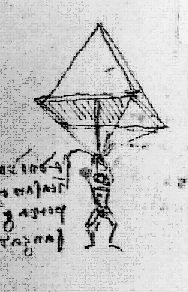 (others
had similar schemes) with flexible hang lines that was so symmetrical that the
glide was not at all intended as the glide would have been extremely tiny.
So, just maybe your aircraft was a kind of first hybrid, and with a flexible
triangle control frame with "frame" here flexible. Today, we look at the
interesting Paramontante morph from flexible to rigid control framing beneath
shroud lines for partly upper-framed ram-air paraglider hang glider.
See:
Parachute.
Theoretically, it is nearly impossible to
have a zero L/D in a "parachute" and thus almost all parachutes are hang
gliders at one end of the "framing" spectrum. JpF
30 March 2010
(others
had similar schemes) with flexible hang lines that was so symmetrical that the
glide was not at all intended as the glide would have been extremely tiny.
So, just maybe your aircraft was a kind of first hybrid, and with a flexible
triangle control frame with "frame" here flexible. Today, we look at the
interesting Paramontante morph from flexible to rigid control framing beneath
shroud lines for partly upper-framed ram-air paraglider hang glider.
See:
Parachute.
Theoretically, it is nearly impossible to
have a zero L/D in a "parachute" and thus almost all parachutes are hang
gliders at one end of the "framing" spectrum. JpF
30 March 2010
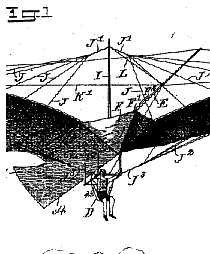
Note on early century image to the
right: If the pilot simply moved hand asymmetrically or operated legs
asymmetrically, then he
could control some gliding and affecting the
path downwards off vertical and thus obtaining a positive L/D. Indeed, the
drawing have some asymmetry on the hand placement. ===============>
Indeed, contemporary hang
gliders (using the at-least-by-1908 rigid triangle control frame (TCF) stayed
by flexible lines and with pilot behind the TCF) have the basebar in tension
replaceable by a non-rigid line (though some advantages would be set aside).
JpF 30 March 2010
http://ntrs.nasa.gov/archive/nasa/casi.ntrs.nasa.gov/19660017784_1966017784.pdf
http://www.energykitesystems.net/Rogallo/FrancisRogoallo1954IntroFlexibility.pdf
http://www.energykitesystems.net/Rogallo/RogalloResearchOnFlexibleWings.pdf
http://www.energykitesystems.net/Rogallo/AnnotateBiblioParaglidersJan1963pub.pdf
http://www.energykitesystems.net/Rogallo/MannedSpaceFlight239to242.pdf
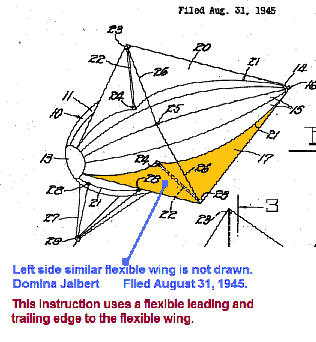
Filed in January 17, 1964.
Notice that severe work for two decades had preceded this by Francis Rogallo
toward unframed and framed flexible wings:
Tony, you had the "tether-control-flexible "frame"" in 1960 for lift-off by a
13-year old self footing for rise.

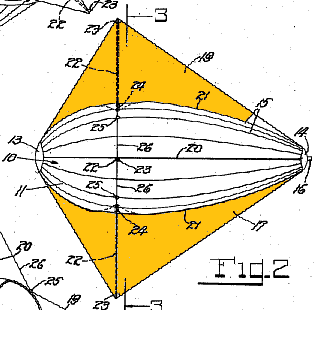
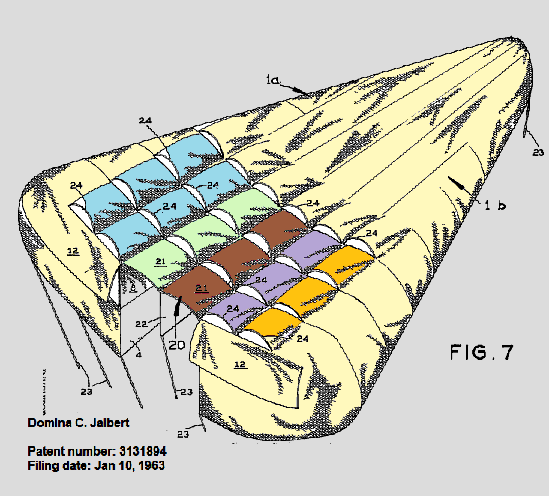
Further comments and links are invited related
to Tony Prentice's 1960 kite-glider.